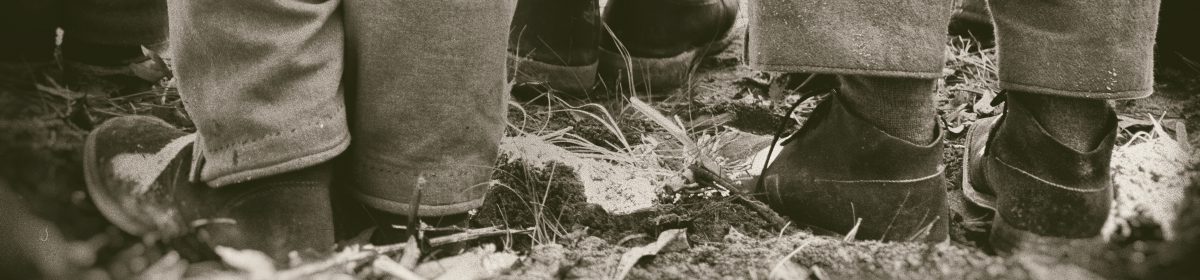
I spent last Sunday afternoon at New Hope Church Battlefield. I was able to photograph the “Hell Hole” ravine as well as the cemetery and church area. I got lucky and thunderstorm clouds began to build and help add to the drama of the scene. There was really horrible thunderstorm 150 years ago to the day, during the battle. I also was able to photograph the dedication of a monument that was being placed near the earthworks behind the old church. It was very touching and several speeches were made and an honor guard posted colors. There was a 21 gun salute and then a three gun artillery battery gave a salute. I made a few new contacts and saw several people that I knew from previous events. I made around 500 images in about five hours. Hopefully I will not get poison Ivy from trudging through the ravine.
150 Years Ago Today: The Battle of New Hope Church
May 25, 1864: General Hood had successfully moved his Corps from Allatoona Pass to the area of the crossroads at New Hope Church. New Hope Church is located several miles Northeast of Dallas. General Hood had his men deploy along a ridge line looking north in the direction of the Union advance. Hood deployed Stevenson’s Division on his right, Hindman’s Division on the left, and Stewart’s Division held the center. When Stewart deployed to the center he placed Stovall’s Georgia Brigade on his left abutting Hindman’s right. Stovall’s Brigade was deployed in the area that is now the cemetery. It was a cemetery then, but has grown in size over the years. My relatives in the 42nd Ga. were positioned some where along Stovall’s line. Stovall’s Brigade decided against entrenching in the cemetery and formed an open line of battle. The remainder of the units on the line entrenched. Multiple artillery units were also deployed along the line.
General Hooker’s XX Corps was moving south from Burnt Hickory where they had stopped for the previous night. Geary’s 2nd Division was leading the Union column as it approached New Hope crossroads. Geary was met with stiff resistance from Stewart’s skirmishers, but was able to drive them back and then came under heavy fire. He realized he had met a large Confederate force and began the process of digging in and sent word for the rest of the Army to move up quickly. Sherman scoffed at the idea of there being a large Confederate force near the area, but he was soon proven wrong. As more Federal troops moved up, Geary formed his Brigades to take the Union Center, Williams’ 1st Division moved to the Union Right and Butterfield’s 3rd Division took up the Union Left. As the Union soldiers advanced toward the Confederate line, the skies opened up and poured down a heavy rain with thunder and lightning. Williams’ 1st Division was the first to reach the Confederate lines and suffered heavy losses. Losing approximately 800 men in the opening few minutes. The remaining Divisions suffered a similar fate with a total loss of approximately 1600. Many were pinned down under such heavy fire that they sought shelter in a deep ravine on the battlefield and were unable to retreat until darkness fell. They later nick named the ravine the “Hell Hole”. That term has also been used to describe the general area and conditions all along the Dallas, New Hope, Pickett’s Mill line. Howard’s IV Corps was called up to support Hooker’s Corp, but arrived to late to be able to have any influence on the battle. The Union Army then began the process of entrenching.
During the battle, Confederate General Johnston sent a courier to Stewart asking if he needed any support. Stewart replied with confidence, “My own men will hold the position”, and they did. He is reported to have been riding back and forth along the line during the heat of the battle, to rally his men. Confederate losses were around 300 to 400. Skirmishing continued throughout the next day.
150 Years Ago Today: The Union Army Crosses the Etowah River
May 23, 1864: General Sherman had devised a plan to move away from his railroad supply lines and angle southwest in an effort to out flank General Johnston’s Confederate Army, who are held up in the fortified positions of Allatoona Pass. Since they were leaving their main supply line, Sherman striped down his army to the just the essential equipment and rations to last a few days. Extra supplies would have to be brought by wagon train from the railroad and would take a great deal of time. On the 23rd of May the Federal troops begin crossing the Etowah River in multiple locations. They used existing bridges that were not burned by retreating Confederates, shallow fords, and the pontoon bridges that their engineers constructed. After crossing the river, the Union troops began concentrating in the area of Euharlee and Stilesboro. From here they moved away as three separate columns. McPherson was ordered to be the right wing of the advance and was sent to take Dallas. He went in a sweeping arch movement far out to the west through Taylorsville, Aragon, and Van Wert (now Rockmart). Sherman’s left wing was made up General Thomas’s and General Schofield’s Armies. From Stilesboro they moved south from that point, but stayed fairly close to each other, in case one of them needed support upon making contact with the Confederates. They stopped in the area of Burnt Hickory for a day to allow McPherson to complete his movement toward Dallas.
Meanwhile, General Wheeler’s Confederate Cavalry were observing what movements the Union Army was making and sent word back to General Johnston. He immediately issued orders to begin moving elements of his army into blocking positions to prevent or delay the Federal Advance. General Hardee was sent to Dallas to stop McPherson and become the left of the Confederate line. Hood stayed at Allatoona Pass for another day and then moved to New Hope to block the advancing Federals. Polk was sent to Lost Mountain where he could move easily in any direction to offer support if it were needed.
Day 4 of Photography is Done!
And what a day it was. I made it Adairsville just before 8:00am and began making images just north of town at the site of the Saxon House. From Adiarsville I traveled south on U.S. 41 to Cassville. I made images at numerous places here. I photographed several churches that were used as hospitals or stables by both Armies at different times. I also made images in the Historic Cassville Cemetery. It was a cool old cemetery. From the cemetery I was able to make images of the locations of the ridge lines that held both the Federal lines on the west the Confederate lines on the east.
From Cassville I traveled south on U.S. 41 into Cartersville. Here, I made images of the Train Depot. It was used as cover by elements of the Confederate Army as the fought a rear guard action during their retreat across the Etowah River. They knocked out bricks in the walls to make shooting ports. It was damaged by Federal Artillery and later abandoned when the rear guard retreated across the river.
From Cartersville I moved south west towards Euharlee, where elements of the Union Army crossed Euharlee Creek via a covered bridge. I made images of the bridge, which was built in the late 1800’s, to replace the one burned during the Civil War. I also went through Stilesboro and made images of Stilesboro Academy. I was also able to make images of Plant Bowen, which sits about half way between Euharlee and the Stilesboro Academy and was along the path taken by elements of the Federal Army. The Army passed by the Academy and used some of the benches as feed troughs for their horses.
I left the Stilesboro Academy and made my way back towards Cartersville and took U.S. 41 south to the Etowah River. On the north bank of the river, on the east side of U.S. 41, is an old abandoned plant for mineral production. On the hill behind the plant was a Federal Fort. It overlooked the Western and Atlantic Railroad as it crossed the Etowah River. I was granted permission by the company that owns the property to make images there. I was attempting to recreate a period image made by George Barnard. The climb up the hill was tough. It was covered with poison ivy, briars, and “Devil’s Walking Stick”. Not to mention all the other undergrowth. I made it to the top of the hill and found the remnants of the old Federal Fort. I am 90% sure I found the spot the images was made. The only problem is all the trees and undergrowth obscured the view. I made the image anyway as well as other images of the remains of the fort. I hiked down the back side of the hill that appeared less steep, but it was even more difficult due to being overgrown. It was the most difficult terrain I have ever gone through to make an image. Looking forward to next week. Lots of action at New Hope Church, Pickett’s Mill, and Dallas.
150 Years Ago Today: Confederate Crossing of the Etowah River
May 20th, 1864: General Johnston and the Confederate Army withdrew from Cassville and on the evening and night of the 20th they crossed the Etowah River and began heading in the direction of Allatoona Pass. General Sherman decided to rest his army and they stayed on the north side of the river for the next three days, where they were resting and restocking supplies.
Having traveled through this area as a young officer, General Sherman knew the dangers of approaching the Confederate Army, at the heavily fortified Allatoona Pass. He formulated a plan to leave his railroad supply line and move southwest toward Dallas and try to out flank Johnston and take Marietta before the Confederate Army could get there.
150 Years Ago Today: Confrontation at Cassville
May 19th, 1864. General Johnston knew that Sherman had taken the bait and that General Schofield’s Corps was moving toward Cassville. Johnston deployed Polk’s Corps across the road that Schofield was traveling and deployed Hood along what would be Schofield’s left flank. At some point in the morning, Union Cavalry, that was attempting to damage the railroad, came across the end of Hood’s Line and attacked. The numbers of soldiers involved were small, but it was enough of a surprise for Hood that he reformed his lines to meet what he thought was a threat and all but abandoned the attack on Schofield. Johnston eventually ordered Polk and Hood to fall back and reform on a ridge about a mile away. The Union Army formed a line in the area that the Confederates had just moved from. They now stood facing each other with the village of Cassville between them approximately at the center of the lines. During the evening, Hood and Polk called for a meeting with Johnston to discuss what they thought would be their inability to hold their lines, due to the position of the Federal Artillery. It would induce and enfilading fire on their lines and there was not a sufficient amount of cover. Johnston relented to their argument, even though he did not agree. He order a retreat and the next day they were across the Etowah River.
150 Years Ago Today: The Cassville Affair, Day 1
May 18th, 1864. General Johnston decided it was time to make another stand and decided to set a trap for General Sherman at Cassville. General Johnston sent Hardee’s Corps from Adairsville south toward Kingston along the main road. He sent all the supply wagon and ambulances down the main road to Kingston as well. This was the bait for the trap. They left an obvious sign that a large number men and material had traveled in the direction of Kingston. Johnston then sent Polk’s and Hood’s Corps on a less traveled road toward Cassville.
When Sherman arrived in Adairsville, he fell for the bait and believed that the majority of the Confederate Army had moved toward Kingston. Sherman then ordered Thomas’s Army of the Cumberland to follow the main road to Kingston and sent McPherson’s Army of the Tennessee on another flanking movement that would take him past Barnsley Gardens. Schofield’s Corps was sent toward Cassville with Hooker’s Corps following along Schofield’s right and slightly behind.
Johnston learned of Sherman splitting his forces and prepared to spring the trap on the next morning at Cassville.
Reenactment at Resaca
Yesterday I went to Resaca for the reenactment. It took place at Chitwood Farms, which is actually on the original battlefield. Even with the rain it was a great time. I was also able to visit the new State Park, which encompasses a large part of the battlefield that parallels I-75, and includes Camp Creek Valley. Most of the Confederate positions were destroyed when the interstate was constructed. The Federal positions are still there and are mostly untouched. I was not able to hike any of the trails in the park, but I think some may lead to some earthworks. The terrain here was beautiful. The park is not actually open yet, but they allowed people to enter this weekend due to the reenactment nearby. I can not wait for it to open later this year. The park is mostly complete, but the DOT is doing construction at the exit off of I-75 and this has the entrance to the park blocked. The are also building and new bridge over Camp Creek next to the entrance. I arrived here at 7:00am and made a few images at the entrance, but the gate was closed. I came back around 3:45pm, after I left the reenactment and spent an hour looking around and making images.
I arrived at the reenactment at 8:00am. I was there in time to see the presentation of colors. After that I watched as the soldiers drilled and practiced their movements for the battle in the afternoon. This was a great time to make images, since we were allowed to walk through the battlefield while they were practicing. I also wandered around the encampments. They were separated by Union and Confederate camps and the Artillery units had their own camps as well as the Cavalry units. Everyone was very friendly and love to talk about what they were doing and why they did it. They were quick to offer a cup of coffee and I even had an offer of breakfast. I walked the “Sutlers” area and looked through their tents. I even bought a Haversack. It worked out good to carry some of my gear when it started raining. I also bought some homemade root beer. It was probably the best root beer I have ever had.
While walking through the Confederate Infantry camp I asked around for the 42 Ga. This was the unit that I had four relatives in and one of them, Milton Brownlee, was wounded here at the Battle of Resaca. I found them and introduced myself to them and told them about my relatives. A few of them knew who Milton was and they all became very reverend when discussing my ancestors and told me it was an honor to meet a descendant. They said they were honored to represent the unit and and my ancestors and hoped they made me proud. They did make me proud. Who knows, when this project is over I may even join up with them.
I wandered through some more of the camps and more Sutlers tents and then found the Photographers tent. As it was raining fairly hard he invited me to take shelter under the tent with several others. I was the only spectator in the tent, the rest in the tent were in “character”. We all talked for awhile and discussed photography, history and my War Was Here project. They were all greatly interested in my project. I wish I had meet a lot of these folks before my kickstarter campaign. I got contact information for them and later while walking around, one of them stopped me to introduce me to someone else who is doing a lot of preservation work and thought we may be able to help each other. Did not realize I was going to be networking here, but it worked out pretty good.
I claimed my spot on the hill to watch the battle. I had a great spot. Front row and “50 yard line” so to speak. I was able to catch almost all the action. Good thing I rented the 500mm lens. Anything less would not have been good enough. My gear drew a lot of attention from the spectators around me and they were all asking questions before the battle started. I explained what I was doing and they were all excited. They were soon jotting down my web address. Hope some of you are reading this now. The battle began with cannon fire and a cavalry battle, followed by infantry fighting and continued cannon fire. There were charges and retreats and the lines changes hands back and forth. Men lay on the field acting dead or wounded and the cavalry clashed with sabers drawn and held high. After an hour of raging battle, the pace slowed down and came to a stop, where all on the field bowed their heads and a pair of buglers played “Taps”. The spectators erupted with a thunderous roar and applause and thanked the soldiers for show. I know the soldiers had good time, because they were all smiles. Afterwards, some Union Cavalry came over to the spectator area to talk to the crowd and answer questions. They were representing the U.S. 2nd Cavalry and had driven in from out of state to participate in the event. I had a great time at the reenactment and I will certainly be going back next year. I think I will take the boys with me, they would love it.
My time was running short so I headed out shortly after the battle and made my way back over to the state park. I made my images and spent an hour there. I finally made it home 12 hours after I left. I had spent 9.5 hours making images during the day and rest of the time was drive time. I filled up few 16 gig memory cards and had about 2500 images for the day. Not to bad I guess, now I just have to edit and edit and edit.
150 Years Ago Today, Battle of Rome Crossroads
May 16th, 1864. In the early morning hours of the 16th, the Confederate Army slipped away across the the Oostanaula River and the supply wagons were moving south. The day before, the Union Army had established a bridgehead at Lay’s Ferry. On the morning of the 16th, the Army of the Tennessee, began it’s advance from Lay’s Ferry. Sweeny’s 2nd Division of Dodge’s XVI Corps was the leading element of the advance, the remainder of McPherson’s Army of the Tennessee followed Dodge’s Corps. They were headed toward Rome Crossroads, where the Rome-Calhoun Road and the Sugar Valley-Adairsville Road met. To meet this threat to the Confederate flank, General Johnston sent General Hardee’s Corps. Hardee’s Corp formed up in the woods south of the road and used Oothkalooga Creek to anchor the right of their line which extended westward parallel to the Rome-Calhoun Road. General Clebrune’s Division held the left of the line and General Walkers Division held the right of the line. Bate’s Division was held in reserve.
As the Federal troops approached the crossroads, Hardee’s line of battle sprinted out of the woods in a surprise attack, catching the Federal skirmishers off guard and pushing them across the road. Hardee used his artillery to target the Federal supply wagons that were following the advance. Hardee and his Southern Soldiers held fast to their position until the early hours of the morning of the 17th. This allowed enough time for the Confederate wagon trains to make it through Calhoun and move southward to Adairsville.
150 Years Ago Today: Battle of Resaca, Day 2
May 15th, 1864, the Battle of Resaca rages on and General Sherman attempts to out flank the Confederate Army. Sherman has General McPherson hold the position he gained on the day before at the mouth of Camp Creek at the Oostanaula River. He then orders Sweeny’s 2nd Division, who is reenforced by Kilpatrick’s Cavalry Division, to attempt a crossing of the Oostanaula River further south at Lay’s Ferry. Sherman ordered the units on the west side of Camp Creek to hold their lines and ordered Hooker’s and Howard’s Corps, on the north of Resaca, to attack the Confederate lines.
Along the norther Confederate line, Stevenson Division was in place and Capt. Maxillian Van Den Corput’s battery, the Cherokee Georgia Battery, was in place in advance of the main line in an effort to catch the attacking Federals in enfilading fire. The battery consisted of four 12 pounder Napoleon guns. This became a hotly contested part of the line. On the night of the 14th, General Johnston learned that Sweeny had withdrawn from Lay’s Ferry and was not able to cross the river. He then ordered General Hood to attack the norther part of the Federal line. This was around 4:00pm, General Hood ordered Stevenson and Stewart to attack, but by this time in the afternoon Stevenson was already under attack by Hooker’s Corp. After the attack had begun, General Johnston was informed that Sweeny was attempting to cross at Lay’s Ferry again. Johnston, fearing that railroad near Calhoun would taken by the Federal troops and his supply line compromised, ordered Hood to cancel the attack. It was too late and Stevenson was already heavily engaged and suffered significant losses. One of the major losses was Van Den Corput’s battery, the artillery men were forced from their works back to the main Confederate Line. The area around the battery became a no man’s land. During the night, Union soldiers were able to capture the Confederate cannons by digging through the earth berm in front of them and dismantling them and with the aid of ropes, dragged them back the Union lines.
After learning of Sweeny’s crossing and the threat to his supply line, Johnston ordered a retreat from Resaca.
 War Was Here