June 18th, 1864

June 18th, 1864

Heavy fighting happened today around the Latimer Farm portion of the Brushy Mountain – Mud Creek Line.  The Marietta Country Club now sits on the former site of the Latimer Farm.  The Confederate lines around the Latimer Farm formed a Salient angle, often called Hardee’s Salient, it was vulnerable to enfilading fire.  Confederate positions were under near constant bombardment from Federal artillery positions no more than 1200 yards away.  Three Federal Divisions, under the command of General Thomas, attacked the three Confederate Brigades at the Salient. The Union troops pushed the Confederate skirmishers back to their main lines and Federal troops soon occupied a trench line in front of the Salient.  Once this line was occupied by the Federal troops, General Johnston realized the chances of the being overrun were high.  On the night of the 18th, he ordered the evacuation of the line and the Confederate line then moved back to the famous Kennesaw Mountain Line.

_DSC0195.bw
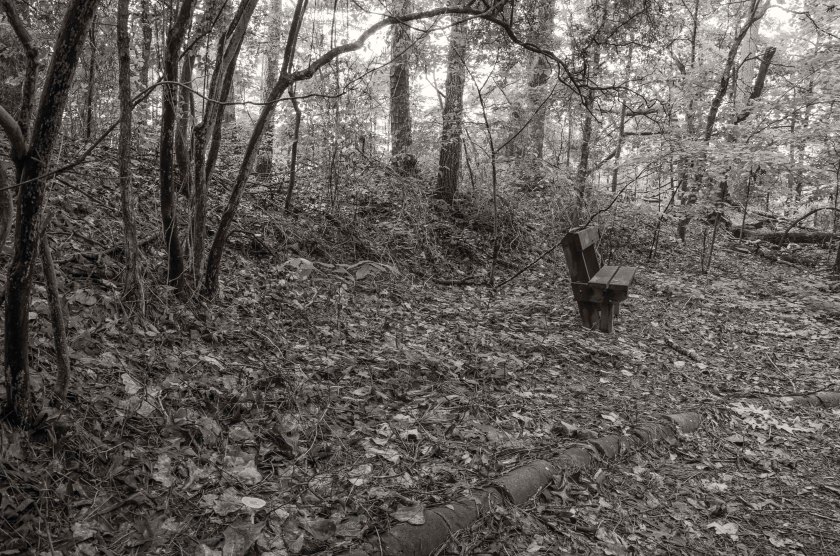
 Remnants of Confederate earthworks that were used during the Battle of Latimer’s Farm.  Now located within the Barrett’s Green Subdivision, they were preserved in the local SCV Camp McDonald in conjunction with the builder.  This area was under a near constant artillery bombardment.
_DSC0421.bw
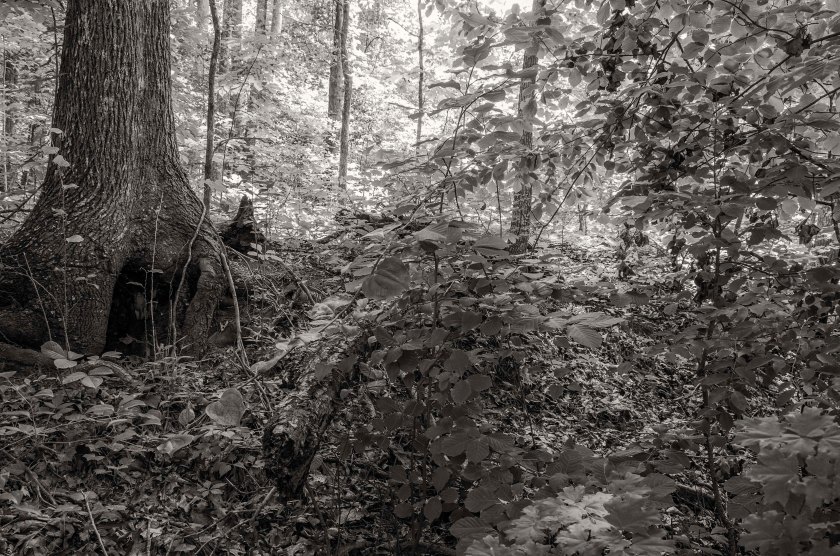
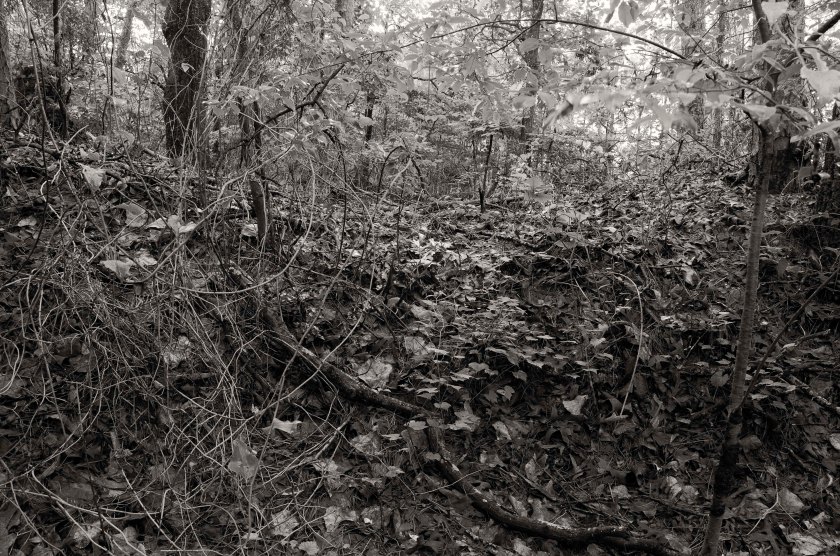
While hard to discern due to the undergrowth, this images shows a line of several Federal artillery positions.  The are called Lunettes.  It is rare to have some so well preserved and these have been protected on private property.  The property is now being developed into a subdivision and the Lunettes are being protected through the work of the local SCV Camp McDonald and the developer.
_DSC0435.bw
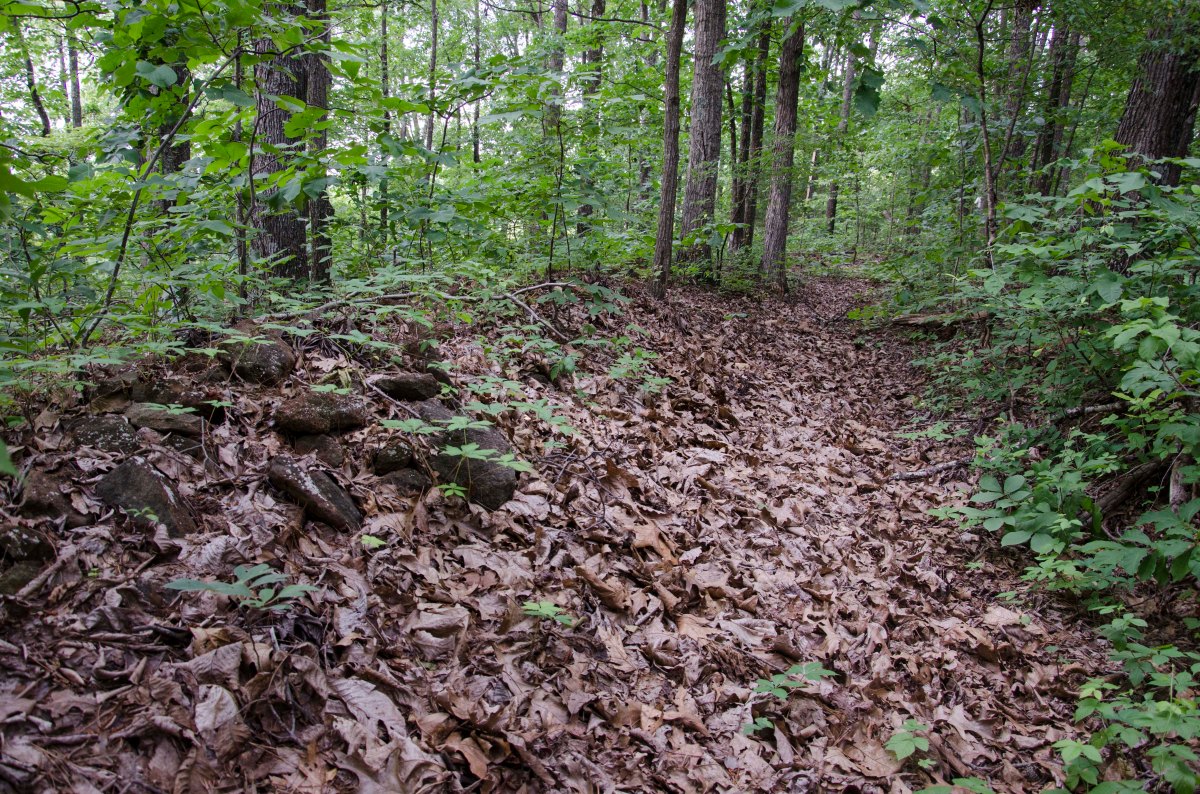
Remnants of Federal earthworks located on the same property as the Lunettes above. 
_DSC0507.bw
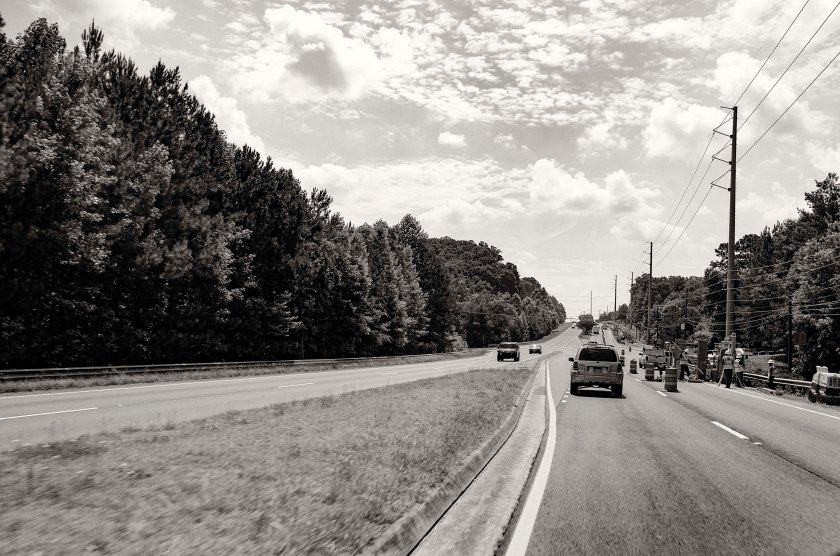
Efforts by the local SCV Camp McDonald and the developer to prevent the destruction of the remaining earthworks.
_DSC0078.bw
This shallow depression is all that remains of this section of Confederate earthworks in the area of Hardee’s Salient.  They are located on private property that has been farmed for sometime.
_DSC0115.bw
The small collection of minie balls found on the property of a farmer who owns the property where the previous image was taken.  He grew up on the family farm and still lives there today and as a teenager he claimed to have found a 55 gallon drums worth of minie balls in the fields which he sold to collectors.  Look close and you may see one with teeth marks…
_DSC0129.bw
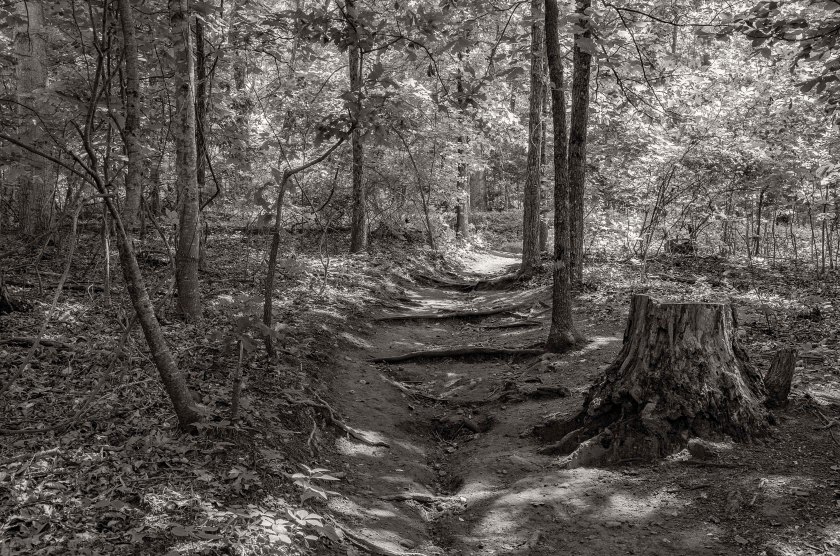
 Now covered with trees and thick underbrush, these remnants of Confederate earthworks, that were part of Hardee’s Salient, now sit quietly behind a local church.

June 17th, 1864

June 17th, 1864,

Heavy skirmishing continued along the Lost Mountain, Mud Creek, Brushy Mountain Line.  Heavy engagements happened in the area of Latimer’s Farm, now the Marietta Country Club.  Calvary actions were also happening continuously on both flanks.  General Johnston begins planning to move to his next defensive position at Kennesaw Mountain.  General Sherman, who has become frustrated, begins to contemplate a direct assault on the Confederate lines as opposed to a flanking movement.

_DSC0239.bw
 Looking south east along Hwy 120 where it crosses Mud Creek.  The Confederates dug in atop the low rise in the distance in an attempt to stall the Federal advance as it crossed Mud Creek.  Many, if not all, of the earthworks are now gone and are covered my subdivisions and shopping centers.
_DSC0007.bw
Confederate earthworks at the far left (west end) of the Brushy Mountain Lost Mountain line.  These works were manned by Jackson’s Calvary.  These works were preserved by the local SCV Camp McDonald in conjunction with the Subdivisions builder and HOA.  They are now preserved as a small park for the subdivision. 
_DSC0026.bw
 Earthworks on the extreme right (East side) of the Brushy Mountain Lost Mountain line.  These works are located on Brushy Mountain in a small subdivision.  They are protected as a small park with historical information signs.
_DSC0264.bw
“Hoods Fort” on Brushy Mountain stands a large earthwork fortification along with several thousand feet of preserved trenches.  The exact purpose of the large fortification is unknown, but many speculate it was used as a ammunition bunker.  You can get a sense of the scale from this image as you can look down the slope to the base of the fortification. 
_DSC0394.bw
 A section of trenches curves its way around the base of the site known as “Hood’s Fort”

June 16th, 1864

June 16th, 1864:

After the fighting at Gilgal Church on the 15th and continued fighting on the 16th, the Union Army has figured out that lines in the area form a salient and begin to pour in enfilading fire on the Confederates.  Other Union forces move against the thin line of southern soldiers west of Gilgal Church towards Lost Mountain.  Schofield’s XXIII Corps is now in a position to turn Johnston’s left flank, Schofield may or may not realize that he is in such an advantageous position, but Johnston does and orders Hardee’s Corp to pull back at dark, to the far side of Mud Creek and establish a new line.  During this retrograde movement, a Union artillery shell explodes near Brigadier General Lucius Polk.  He is the nephew of Lt. Gen. Leonidas Polk and only two days after the death of his Uncle, Lucius Polk is wounded and loses his leg.

_DSC0004.bw
Recreation of what Confederate earthworks may have looked like.
_DSC0080.bw
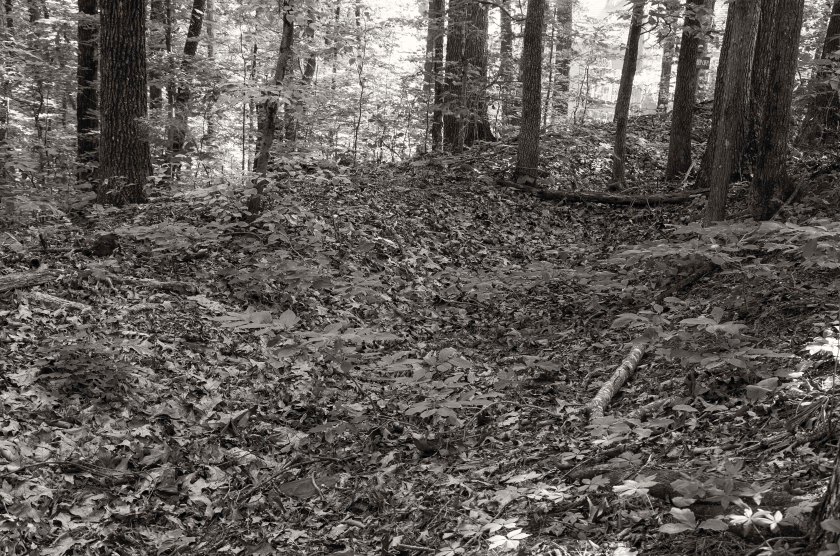
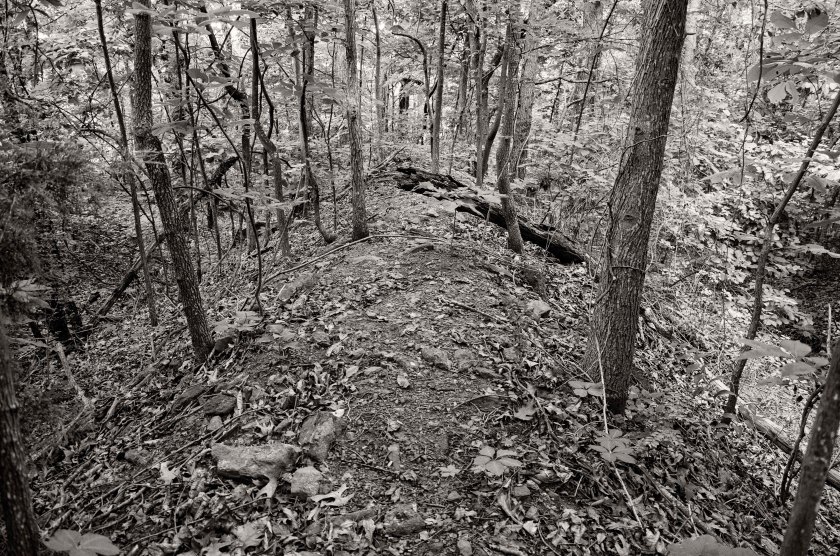
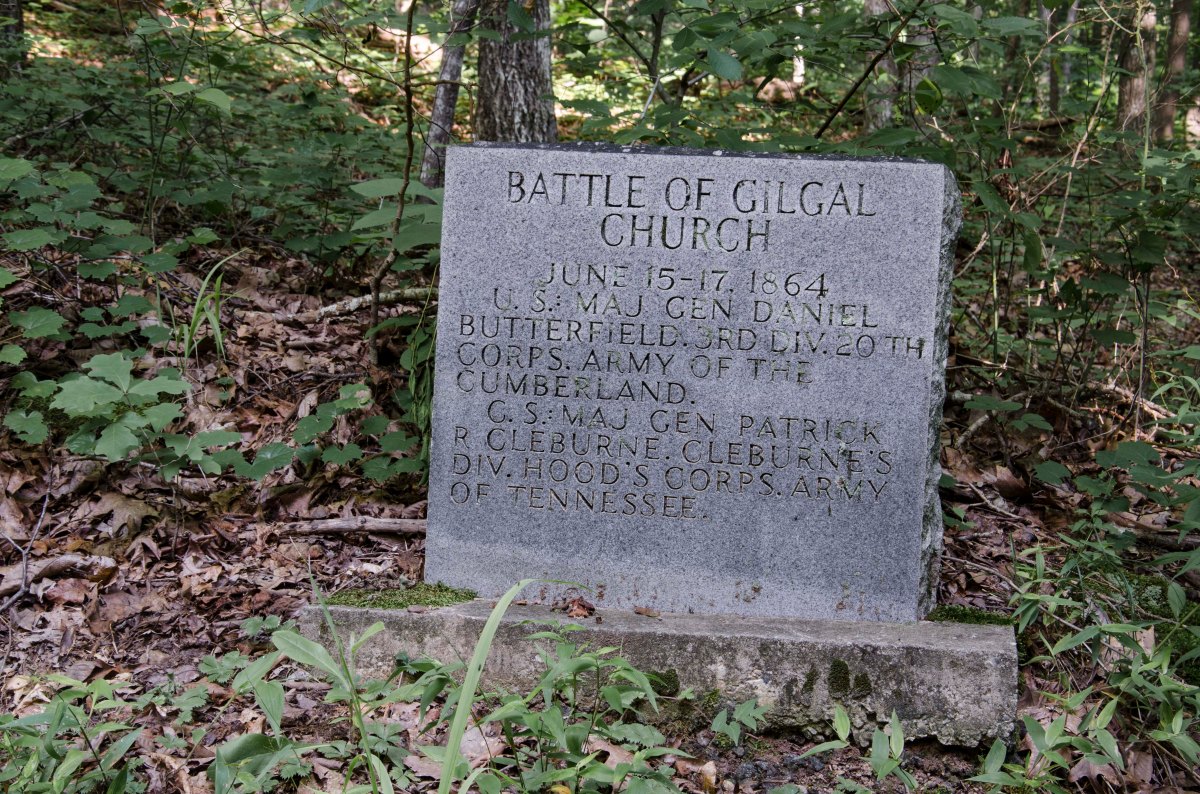
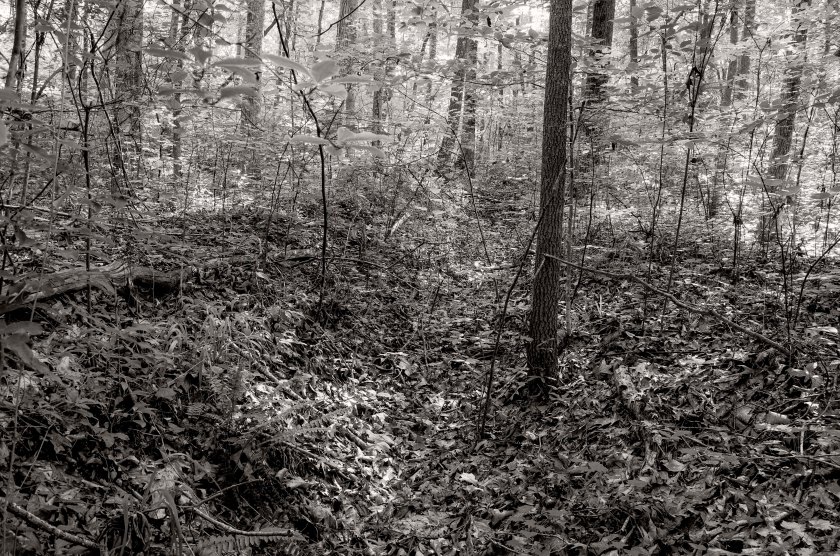
 Remnants of Confederate earthworks at the site of the Battle of Gilgal Church.

Death of the Fighting Bishop

June 14th, 1864

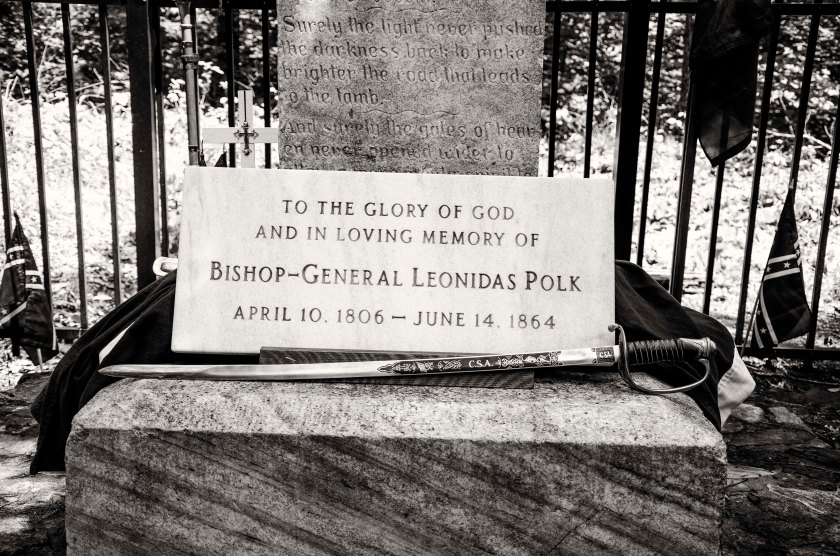
Being concerned that the position of Bate’s Division on Pine Mountain was quickly becoming compromised, Confederate Generals Johnston, Polk and Hardee, rode to the top of the mountain on the morning of the 14th.  As the Generals were inspecting the position, they were observed by members of a Federal artillery battery located about a mile to the north east of the mountain.  This was the 5th Indiana Battery.  They observed what appeared to be officers on the mountain and opened fire.  The first round buried it’s self in the parapet of the Confederate position and the second round struck General Leonidas Polk in the chest killing him instantly.  Polk, also called the Bishop General was the Episcopal Bishop of Louisiana and was greatly revered by his men.  His death struck a serious blow to the Confederacy.

Later on the 14th, Federal forces attacked Pine Mountain in an attempt to cut it off from the main Brushy Mountain Lost Mountain line.  Pine Mountain formed a salient in the Confederate lines and was just over a mile to the north of the main line.  The Federals pushed hard to cut Pine Mountain off from their main line, but were repeatedly repulsed by the well entrenched and fortified positions of the Confederates of Bate’s Division.  General Johnston ordered Bate’s Division to with draw from the position on the night of the 14th under the cover of darkness.

CMB_0002.bw
Location on top of Pine Mountain were General Leonidas Polk was fatal struck by an artillery round from the 5th Indiana Battery
_DSC0059.bw
Remnants of the parapet the took the first round from the 5th Indiana Battery. 
CMB_0005.bw
Earthworks atop Pine Mountain.  These were manned by Bate’s Division.

_DSC0033.bw
Now located behind a church, this is the position of the 5th Indiana Battery that fired the fatal shot killing General Leonidas Polk.  It has been turned into a small nature trail for the church.
_DSC0020.bw
Looking through the notch in the parapet wall of the 5th Indiana.  One of the artillery pieces would have fired through this notch in the wall.
_DSC0112.bw
From the 150th anniversary memorial ceremony held on Pine Mountain, June 14th 2014.
CMB_0037.bw
F.D.Polk IV, 3rd Great Grandson of the General Leonidas Polk was present at the memorial service.
CMB_0056.bw
During the memorial service a reenactor was portraying a Reverend and presided over the memorial service.
_DSC0043.bw
Surviving Confederate earthworks of Bate’s Division where they repulsed the Federal attack on June 14th along the base and slopes of Pine Mountain.

_DSC0089.bw

Surviving Confederate earthworks of Bate’s Division where they repulsed the Federal attack on June 14th along the base and slopes of Pine Mountain.

_DSC0103.bw

Surviving Confederate earthworks of Bate’s Division where they repulsed the Federal attack on June 14th along the base and slopes of Pine Mountain.


150 Years Ago Today: Dec. 18th – Dec. 24, 1864

General Hardee has had his forces quietly construct a pontoon bridge across the Savannah River.  They constructed it out any boat or pretty much any floating object they could use.  On top of the boats, boards were placed to make a road.  They then placed straw and hay on top of the bridge to dampen the noise of travelers.   On the night of Dec. 20th, Confederate forces withdrew from Savannah and crossed the pontoon bridge into South Carolina.

Dec. 21st, at 4:00am, Federal forces were met on the outskirts of town by the Mayor and aldermen.  They formally surrendered the city and requested protection from the Federal Army.  Word was immediately sent to General Sherman, who was meeting with Navy Officers.  Sherman was taken back to King’s Bridge.  From there he rode into Savannah.

Dec. 22nd, General Sherman entered Savannah and established his headquarters at the Pulaski House.  While working out the details here, an English merchant, Charles Green, offered the General his home as his Headquarters.  General Sherman accepted and the Headquarters was moved to the Green House.  It was here that Sherman penned his famous telegram to President Lincoln.  It read as follows: 
            “I beg to present you as a Christmas gift the city of Savannah, with one hundred fifty heavy guns and plenty of ammunition, also about twenty-five thousand bales of cotton.”

Dec. 24, President Lincoln receives Sherman’s telegram.  The telegram is published in newspapers across the country.  Lincoln replied with “Many, many thanks for your Christmas gift, the capture of Savannah, but what next?”

The March to the Sea is complete.  Sherman has reached his goal of Savannah and now has control of the city.  Camps are established and order is maintained.  Sherman’s Chief Engineer, Orland Poe, is reconstructing and fortifying the cities defenses.  The mines and obstructions are removed from the Savannah River and the port is reopened.  The citizens are encouraged to go back to life as normal, as as much of normal as can be expected under occupation.  Freed Blacks begin working for the Federal Army in various roles and schools are established for them in places that were once used in the slave trade.  Sherman rests, repairs, and refits his Army for there is more to come.
150 Years Ago Today: Nov. 23 – Nov. 27, 1864

Nov. 23rd, 1864: 
     The Left Wing of Sherman’s army moves into and occupies the Georgia State Capitol of Milledgeville.  At one point, soldiers occupy the state house building and hold a mock session of the legislature.  They have speeches and vote to repeal secession.  General Sherman takes the Governor’s Mansion as his headquarters.  The Governor had taken all the furnishings with him to Macon leaving the mansion empty.  Sherman slept in his bedroll on the floor. 
     The Right Wing reaches the Oconee River north east of Macon.  After passing through McIntyre and Toombsboro they are delayed at Ball’s Ferry by stiff Confederate resistance. 

Nov. 24th, 1864:
     General Kilpatrick takes his cavalry column and leaves the Right Wing and feints toward Augusta with elements of the Left Wing.  General Hardee arrives at Ball’s Ferry to assess the situation.  He decides that their lines must be abandoned and they withdraw during the night. 
     They Left Wing begins to leave Milledgeville and moves through Hebron.

Nov. 25th, 1864:
     The Left Wing begins to move towards Sandersville and begin to meet active Confederate resistance and begin to skirmish almost constantly as they advance.

Nov. 26th, 1864:
     The Right Wing occupies Oconee and have taken the abandoned lines of the Confederates at Ball’s Ferry.  The Left Wing enters Sandersville where they clash with cavalry as the enter town and fight a running skirmish through the town square.  Elements of the Left Wing move out from Sandersville and move toward Tennille and Davisboro. 

Nov. 27th, 1864:
     The Left Wing has reached the Ogeechee River and begins to cross at Fenn’s Bridge.  A series of sharp cavalry battles ensue in the area of Waynesboro when Sherman feints toward Augusta.  The Left Wing also provides support for Kilpatrick as he operates and clashes with Wheeler between Millen and Waynesboro. 
     

150 Years Ago Today: November 22, 1864

November 22, 1864:
     The 20th Corps, part of the Sherman’s Left Wing, reached Milledgeville.  They marched into town past unoccupied Confederate earthworks and were completely unopposed.  Mayor R.B. DeGraffenreid surrendered the town and asked for protection from looting and destruction.  Two regiments camped on the state house grounds and acted as the provost.  They also raised the first U.S. Flag over the state house since the start of the war. 
     The Right Wing fought what is thought to be the largest battle of The March to the Sea at the Battle of Griswoldville.  On the morning of the 22nd, General Hardee dispatched three brigades of Georgia Militia from Macon to August to help defend the city.  Hardee was hoping that the Federal column had already passed and that the militia would be moving behind them and have a clear path to August.  Weather and choked roads, along with delaying actions by Wheelers cavalry, had caused the Right Wing to slow down.  The Militia were under orders to retreat if the encountered any resistance.
     General P.J. Phillips was in command of the Militia, after they marched north east from Macon they met up with the 4th Brigade that had marched out the night before.  They told Gen. Phillips about the skirmishing between Wheeler and the Federals.  Phillips also learned that his detachment outnumbered the Federals and decided to disobey his orders and attempt to overrun the Federal position.  They were to attack across open fields that were nearly 700 yards in distance and try to reach a deep ravine about 100 yards from the Federal lines.  The Federals were caught off guard by the attack as it came unexpectedly, but they quickly regrouped and formed up for a fight. 
     The Militia, made up of old men and young boys, made a concerted, if not confused, effort to attack the Federal position.  Many of the Militia had never seen combat, some fired on their own men by mistake, some even attacked in the wrong direction.  The battle hardened veterans of the Federal army opened up with a withering fire from their position and the bodies of the dead and dying Militia were littering the field.  Yet they still advanced, time and time again under the constant fire of the Federals.  The Militia reached within 50 yards of the Federal line before they finally retreated.  The Militia lost 51 men killed and 472 wounded.  The Federals lost 13 men and only had 79 wounded. 

150 Years Ago Today: November 21, 1864

November 21, 1864:
    Parts of the Right Wing of Sherman’s army pass through Gordon and move on east to Irwinton.  Their column stretches out for miles as they choke the roads.  The Left Wing continues to move closer to Milledgeville.  Sherman remarks in his memoirs that they on made 8 miles on this day in a hard, cold, windy day.  That night an uncommon early season snow storm blanketed the army with snow.  The southern civilians accuse the yankees of bringing the cold weather with them.
    General Hardee, in command of the Confederate forces in Georgia, is in Macon where he has been preparing to defend the city.  His scouts have reported that the Federal columns have turned away from Macon and have started on a move eastward.  Hardee now realizes that the Federal objective is most likely Augusta or Savannah.  General Hardee begins to shift his troops as well as Wheelers cavalry to the east in an effort to slow down the Federal Advance. 

150 Years Ago Today: November 19th, 1864

November 19th, 1864:
     The 20th Corps, part of the Left Wing, made their way through Social Circle and Rutledge to Madison along the way they destroyed the Railroad and any thing that could be used to support the Confederate war effort.  From Madison, General Geary took a Division to Buckhead, near the Oconee River.  In Buckhead, Geary’s Division burn the Railroad Depot, 500 bales of cotton, 5000 bushels of corn.  They also burned the Ferry and boats on the river as well as the railroad bridge that was over 400 yards in length.  General Sherman, who was traveling with the 14th Corps of the Left Wing, moved through Shady Dale and Newborn, destroying both as they were working their way towards Milledgeville.  Sherman and the 14th Corps also crossed the Alcovy River during the day. The Right Wing continued to make progress on their move south toward Clinton.

150 Years Ago Today November 18th, 1864

November 18th, 1864:
     The Left Wing continues to move towards Milledgeville.  General Sherman is still traveling with the 14th Corps and they turn south from the area of Covington and move towards Milledgeville via Shady Dale.  The 20th Corps moved on Madison where they destroyed the railroad and Geary’s Division was sent to the Oconee River to destroy the bridges crossing.  After the completed their assignments, the 20th Corps was to move south through Eatonton to link up with the 14th Corps near Milledgeville.  The Right Wing crosses the Ocmulgee River and begin moving south east.  They are working their way toward Monticello and toward Clinton, which is just north east of Macon. 
     The Federals process of foraging was in full swing.  The “Bummers” as they were often called, would leave the camps in the morning ahead of the main column and move out to the flanks.  Along the flanks they would visit every home and plantation and take their food and livestock.  There are many accounts of the”Bummers” also taking personal items and random keepsakes.  There are even accounts of the soldiers stealing and wearing ladies dresses.  For the most part, if there was more food than the soldiers could carry or use, they would destroy it so it would be of no use to an Confederates that may come around.