August 7th, 1864:
On the morning of the seventh, the Federals again began to advance on the entrenched Confederates south of Utoy Creek. They encountered no resistance and found the Confederate works empty. Bate’s Division was withdrawn from the lines overnight and took their place in the line of defensive works, that stretched from the defensive perimeter around Atlanta, to the southwest in order to protect the railroads in East Point. Bate’s takes his place between Clayton’s Division on his right (north) and Clerburne’s Division to his left (south).
Sherman, who is displeased with the failure of the movement toward East Point, decides to lay siege to Atlanta and will do his best to run the Confederates out of the city. He begins to shell the city and considers the city itself as a military target even though there are still civilians within the city. Many have evacuated, but several thousand have no where to go or have decided to wait it out.
Category: http://schemas.google.com/blogger/2008/kind#post
150 Years Ago Today: August 6th, 1864 The Battle of Utoy Creek
August 6th, 1864: The Battle of Utoy Creek
This morning, Sherman has accepted the resignation of Palmer, who will be on a train back to Chattanooga by the afternoon, and the Federals had formed up their lines and everyone was in place to attempt an advance across Utoy Creek towards the railroad in East Point. With Palmer’s resignation, Robert W. Johnson, a division commander within the XIV Corps, was appointed Commander of the XIV Corps and placed under the command of Schofield. Displeased with the performance of the XIV Corps on the previous day, Schofield had moved his XXIII Corps to the right of the XIV Corps. The XXIII Corps is now the Federal right flank and the XIV Corps is the left flank with Logan’s XV Corps in support to their left. Palmer’s Corp was fanned out in an arch following the current Beecher Road south to Benjamin E. Mays and making a slight turn to the west, just north of Cascade Road. Palmer’s right ended near Willis Mill Road. Schofield’s left was adjacent to Palmer’s right with Cox’s Division along Cascade Road and stretching out west. Hascall’s Division of Schofield’s Corps turn south making a 90 degree turn to the south and was facing the end of the Confederate line at the Confederate left flank.
The battle began when Cox’s Division moved south and Hascall’s Division moved east to press the Confederate flank. The 11th Kentucky Regiment (Federal) of Cox’s Division was at the front of the advancing line and made first contact with the 4th Kentucky (CSA), who were posted as skirmishers in front the famed Kentucky Orphan Brigade. This action happened in the area of the waterfall in what is now Cascade Springs Nature Preserve. Cox’s attack was repulsed and a severe loss. He reformed for another attempt, but was repulsed a second time after which he withdrew from the assault. Hascall was hindered by the South Fork of Utoy Creek and made minimal gains in his assault. He did reach the rear of an artillery battery, which withdrew to the east to another position on high ground from which they still had a commanding view.
Palmer’s Corps, now commanded by Johnson, has sat idle most of the day and did not make an attempt to attack until late afternoon and he only attacked with one division. He gained no headway and retired before anything larger than a skirmish developed.
The Confederate left flank was manned by Bate’s Division along a ridge line just south of Sandtown Road (Cascade Road). S. D. Lee’s Division connected to Bate’s right at the Sandtown Road east of what is now Beecher road. Bate’s left flank was open and vulnerable to attack and on the night of the 6th, Hood ordered Bate’s Division to withdraw from the area back to the Confederate main defensive line.
150 Years Ago Today: August 5, 1864 The Battle of Utoy Creek
August 5th, 1864:
The conflict between General’s Sherman, Palmer and Schofield continued throughout the day. Palmer sent multiple letters arguing back and forth with Sherman. Palmer’s final letter said “I will call upon you tomorrow morning and present a formal application to be relieved.” While they bickered back and forth, Federal units were still trying to get in line for the move toward East Point. For the remainder of the day Palmer agrees to relay orders from Schofield to his XIV Corps. Baird’s Division advances south toward Utoy Creek and encounter the Confederate skirmishers. They take about 140 prisoners. They then turn towards the east and encounter an artillery barrage. They decide not to advance and assault the Confederate works as they assume they will be repulsed. Davis brings his division up along side Baird’s and comes to halt as well. Schofield is not happy about the assault coming to a halt. He orders Johnson’s Division of Palmer’s Corps to swing around the right and attack the Confederate left flank. Johnson waits until early evening to begin his movement, which he calls a “reconnaissance”. He move a very little distance and then calls it off since it is too late in the day to do much good. He falls back to the rear of Davis. Schofield and Sherman are both displeased with the performance of Palmer’s XIV Corps. Palmer will resign in the morning and for a time Johnson will command the XIV Corps.
During the night of the 5th, Hood orders the defensive lines extended further south and west to protect the railroad in East Point. The line extended about 1.25 miles from the existing defensive lines, down a ridge line the paralleled the Sandtown Road (Cascade Road), and overlooked the North Fork of Utoy Creek. The far left of the line ended in the area of the current Cascade Springs Nature Preserve.
150 Years Ago Today: August 4th, 1864
August 4th, 1864:
With the failure of Sherman’s plan to use Cavalry to destroy the railroad south of Atlanta and cut off the Confederate supply line, Sherman has decided to begin moving a portion of his forces toward the railroad junction at East Point. This is where the railroad from Macon and the railroad from West Point, which leads into Alabama, meet and form a single line coming into Atlanta. If Sherman’s forces can destroy this junction and control it, they will be able to cut off the supplies flowing into Atlanta.
With this in mind, Sherman has sent Schofield and his Army of the Ohio and advance on East Point via the Sandtown Road (Cascade Road). Sherman has attached Palmer’s XIV Corps of the Army of the Cumberland to Schofield and has ordered Palmer to report to and follow the commands of Schofield. The advance was delayed for nearly the entire day as Palmer refused to report to or follow the commands of Schofield. He felt the he was senior to Schofield. They advanced no further than the North Fork of Utoy Creek. The day was wasted through bickering between the Generals and nothing of real tactical importance was accomplished other than a few probes of the Confederate lines, which had be extended as fast as the Union could attempt to turn their flank.
Photography Days 29 and 30 are done!
Photography Day 29: July 28th, The Battle of Ezra Church
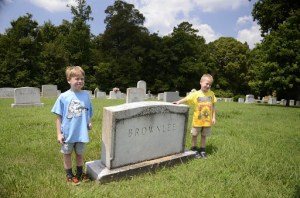
I had the boys with me today and we had a really good day. The Battle of Ezra Church took place in South West Atlanta in the area from Westview Cemetery on the south side to Turner Middle School to the northwest and toward Mozley park to the northeast. It was a very pleasant day with good weather. We made lots of stops in the area that is mostly residential. We then went into Westview and photographed the small set of remaining earthworks and the grave of Lt. Clingman that sits in front of them. We also photographed the monument to the Battle of Ezra Church, the former location of the Alms House (poor house), and the Confederate section of the Cemetery. We had a picnic lunch at the monument to the battle. I have some relatives buried in different sections of the cemetery, so after a call to may Dad for some hints on their locations, we were able to visit their markers. It was a great day all around.
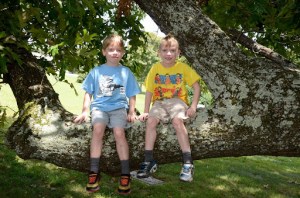
The boys at Westview Cemetery
Photography Day 30: July 30th, The Battle of Brown’s Mill
This was another great day with the boys, they are always so good for me when we go on the road taking pictures. We started in the area near Six Flags and photographed the site of an old house as well as the location of the small skirmish at Sweetwater Creek Bridge. We then headed towards Campbellton and photographed a home that was McCook’s Headquarters on the night of the 27th before he crossed the river at Smith’s Ferry. The home is still occupied and in use today. We then went to the location of Smith’s Ferry. I was able to photograph the period road, which is still in use as well as the exterior of the period home on the site that once belonged to Ferry owner.
From Smith’s Ferry we crossed the Chattahoochee river into Fulton County and Campbellton. Here, I photographed a period home, the Beaver’s House. I remember when some of our family friends, Mr. and Mrs. Fountain, purchased and remodeled the home. It was occupied by them for some time before being sold to Fulton County for preservation purposes. I remember when they were remodeling the home and would find minie balls in the walls. We also photographed another period structure here, the Masonic lodge, as well as the site of the old Latham House. It has since been destroyed, but as a child, I remember going in the house and seeing the dent in the wall where a cannon ball had come through the window and lodged in the wall. In the 90’s it was used as a set for a horror movie called “Body Parts”. From Campbellton we traveled into the Rivertown and Rico areas and made more images of period homes and the terrain where a small skirmished happened after McCook crossed at Smith’s Ferry.
After Rico, we went toward the Redwine area where Hutchesons Ferry Road and Hwy. 70. Here I photographed the old Redwine Plantation home on the corner, as well as two other period homes in the area. From here we moved to Palmetto and on the way we stopped to photograph a period home on Hearn Road, where Hood’s Army of the Tennessee stopped on their way out of Palmetto in September of 1864. They stopped here and picked up 44 bushels of corn. In Palmetto we photographed the former Palmetto Stage Coach Inn, now Barfields Law Office and we also photographed the railroad tracks, depot and monument in town.
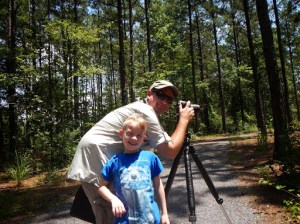
We then moved south to Newnan. Here we stopped for lunch and met an old friend at The Redneck Cafe. The food was great as usual. I photographed the court house square area then we went to the Brown’s Mill Battlefield Park. I gave the boys the point and shoot camera to share and we set out on the trail. There was nonstop laughter along the trail as they made crazy pictures.
After leaving Brown’s Mill we went into town and photographed more period structures, including “Buena Vista”, which was Wheelers Headquarters on the night of the 30th. From here we made a snack stop at the Dairy Queen and then proceeded to the Confederate section of Oak Hill Cemetery.
Since we don’t get to Newnan very often, we met my cousin and her family for dinner and a couple of hours at their neighborhood pool. By the end of the day we were all exhausted and finally made it home after 16 hours.
Boys and I at Brown’s Mill


150 Years Ago Today: July 30th, 1864: The Battles at Dunlap Farm and Sunshine Church
July 30th, 1864:
I again apologize for the lateness of the post as I have been pretty busy for the last few days.
Dunlap Farm:
Since General Stoneman decided not to meet up with McCook at Love Joy’s Station, he continued on toward Macon in an attempt to rescue prisoners being held there. On his way into Macon, Stoneman’s Cavalry destroyed several miles of track along with several bridges and depots. He then moved on Macon in an attempt to take the city. He established his headquarters at the Dunlap House, located in what is now Ocmulgee National Monument. He used his two pieces of light artillery to begin shelling the city and was quickly forced to retreat by Confederates guarding the city.
Sunshine Church:
With Stoneman retreating from Macon, Confederate Cavalry under the command of Brig. Gen. Alfred Iverson Jr., gave chase. Iverson had been born and raised in the area and his knowledge of the area allowed him to get ahead of Stoneman near Sunshine Church (near Round Oak, Ga.). The Confederates place a cannon in the middle of the road and as soon as Stoneman was in range, the began to fire on him. A sharp skirmish ensued and Iverson was able to deceive Stoneman into thinking he was surrounded. Stoneman surrendered himself and 700 troops to Iverson. They were then imprisoned in the very prisons they were trying to reach in an effort to rescue their comrades.
150 Years Ago Today: July 30th, 1864: The Battle of Brown’s Mill
Sorry for the late post. I have been on the road a lot this week.
July 30th, 1864: The Battle of Brown’s Mill
On the 29th, McCook’s Cavalry made it to Love Joy’s Station where they were supposed to meet General Stoneman and destroy as much of the railroad as possible. When McCook arrived, Stoneman was not there, so McCook began to destroy the tracks. Stoneman had been given permission by Sherman to head south towards Macon and Andersonville after destroying the tracks, in an effort to free the Union Prisoners. Stoneman, who was looking to pull off some heroic venture to improve his reputation, decided that McCook could handle the detail at Love Joy’s Station and went straight for Macon.
McCook ended up fighting a fairly heated skirmish at Love Joy’s Station and the began to retreat back towards the west in an attempt to cross the Chattahoochee and return to the safety of the Federal lines. General Wheeler and his Confederate Cavalry were hot on his trail and were engaged in a running skirmish with McCook’s rear guard.
On the morning of the 30th, the front of McCook’s column came into Newnan along what is now E. Broad St. near the train depot. Their path was blocked by a train load of Confederate soldiers that were waiting for the tracks in Palmetto to be repaired. The same tracks that McCook had destroyed a couple of days before. Both sides were surprised by the appearance of the other and a small firefight ensued. Being blocked in the front by the train and having Wheeler coming up on his rear, McCook began moving south of town looking for a clear path to the river where he could avoid a fight. Wheeler’s forces entered town and split up in an effort to hit McCook from the front and rear.
The two forces finally met about three miles south of Newnan near Brown’s Mill along the Millard Farm Road and what is now Old Corinth Road. McCook’s troopers were driven from the road and into the woods where they dismounted and fought on foot. The fighting was intense and Wheeler soon received about 1400 reinforcements that had marched out of Newnan. McCook, thinking he was surrounded, shouted “Every man for himself!” McCook suffered heavy casualties and lost several officers and Brigade Commanders. He decided to split his forces and they cut their way out of Wheelers trap and made off for the river in different directions. A large number of his troopers were captured over the next few days as the Confederate Cavalry continued their pursuit. McCook, lost about 100 troopers to the fight and another 1300 were captured and sent to prison camps. Wheeler lost about 50 troopers.
150 Years Ago Today: July 28th, 1864 The Battle of Ezra Church
July 28th, 1864:
After learning of the flanking movement being conducted by Howard’s Army of the Tennessee, Hood ordered S.D. Lee’s Corps and A. P. Stewart’s Corps to move out the Lickskillet Road in an effort to check the Federal advance and try to roll up their right flank.
Howard began deploying his units on the 27th in an effort to reach the railroad at East Point. He started his line of battle somewhere along what is now Chappell Road south of North Ave. His line followed the high ground along Chappell Road to the south. On the morning of the 28th, Howard began deploying the remainder of his army along the ridge and continuing south down Chappell Road. The Federal line then began to curve to the right (southwest) near the intersection of Ezra Church Drive and Chappell. The line continued its curve through what is now Mozley Park. Ezra Church was located in the park on a grassy hill between MLK Blvd. and the ball fields of the park. Federal units used Church Pews and wood from the church to construct barricades to fire from. The line continued to curve southwest until it reached the point of Laural Ave. and Archer St. This was the salient in the Federal line. From this point it turned in a northwesterly direction. It would have crossed West Lake Ave, passing over part of Anderson and Waterbury and ending on the hill where the current Sadie G. Mays Rehab Center (Nursing Home) is located. This would have been the extreme right of the Federal line that surrounded Atlanta as well as Howard’s right. This hill was called Battle Hill.
Lee’s Corps formed up for battle in the area along the front portion of the current Westview Cemetery. Brown’s Division formed up on the left with Brantley’s Brigade forming on the far left. Clayton’s Division formed on the right with Holtzclaw’s Brigade at the right. Stewart’s Corps formed to the rear of Lee along the Lickskillet Road (formerly Gordon Road and now called Ralph David Abernathy Blvd.). An artillery battery was located in what is now the Westview Cemetery on a hill behind the Alms House (poor house). They Alms House was located in the area just south of Westview’s original entry gate.
In the early afternoon the Confederate attack began. Their movement was screened by thick woods in the area and in some locations they were within 50 yards of the Federal line before they were seen. Brantley’s Brigade on the Confederate left attacked Lightburn’s Brigade on the Federal right in the area of Battle Hill. They were successful at first and were able to take the hill for a short time, but were forced to retreat when several regiments from the reserves of the XV and XVI Corps arrived. Sharp’s Brigade, who held the center of Brown’s Division, advanced on the Federal line through the area of what is now the West Lake Marta Station.
Clayton’s Division of Lee’s Corps was advancing on the Federal line just east of the salient and in the area of Ezra Church. Their repeated assaults were constantly repulsed by the Federals who had the high ground and in some locations had begun to dig in and build barricades. Around 2pm, part of Stewart’s Corps began to advance in support of Lee’s Corps. They concentrated their force in the same area of Clayton’s Brigade, but Stewart was also unsuccessful in his attack. Stewart was wounded in the fighting on a hill on the south side of MLK Blvd between Federal Drive and Gordon Terrace. Stewart was about to send additional units into the fight when he was wounded and carried from the field. Walthall, one of Stewart’s Divisional commanders assumed command and instead of sending in more soldiers, he began to withdraw from the area.
After being repulsed by the Federals multiple times and the coming nightfall, the Confederates pulled back to their jumping off point and began to dig in. Some of the works are still visible in a section of Westview Cemetery. This was the third defeat for Hood in his short time as the commander of the Confederate Army of Tennessee. While they did not defeat the Federals, they did prevent their move on East Point, at least for the time being and as fast as the Federals tried to go around the Confederate flank, the Confederates just a little faster in building earthworks and extending their line.
150 Years Ago Today: July 27th, 1864
July 27th, 1864:
After the death of General McPherson during the Battle of Atlanta, General Logan assumed command during the battle and retained it for several days while General Sherman decided who should replace McPherson. Sherman, being a graduate of Westpoint, had a certain disdain for political Generals like Logan, and did not trust them to follow orders properly and promptly as they were on the field of battle for political gain. With these thoughts in mind and after consulting with General Thomas of the Army of the Cumberland, Sherman chose General O.O. Howard to command the Army of the Tennessee as McPherson’s successor. General Hooker is so offended and outraged that he was not given command of the Army of the Tennessee, the he resigns his commission and leaves the Army. Howard assumed command on the 27th of July and his order of the day was to shift the Army of the Tennessee from the east side of Atlanta near Decatur, to the west side of Atlanta by moving to the north and around the top of the city. His ultimate objective is to move on Eastpoint and destroy the railroad.
Sherman has Cavalry units dismount and fill the lines of Howard’s army as they began to pull out. He also ordered infantry units along the line to skirmish heavily with the Confederates in the cities defensive lines in hopes of screening Howard’s move. Sherman was attempting to flank Hood out of the city and draw him into a fight or cut off Hood’s supply line from the railroad to Macon and the railroad to Westpoint.
Stoneman’s and McCook’s Cavalry were sent on a raid to destroy the railroads while the Army of the Tennessee was moving into place. Stoneman went south out of Decatur and McCook moved southwest from Turner’s Ferry. McCook and Stoneman were scheduled to meet at Love Joy’s Station on the 28th to destroy the railroad. McCook went southwest along the west bank of the Chattahoochee and crossing on pontoon bridges at Smiths Ferry, about 6 miles south of Campbellton. He moves on toward the east and in Palmetto he destroys several miles of track, burns the depot and then moves towards the east again in the direction of Fayetteville. Along the Fayetteville road the come across a Confederate wagon train. They take about 300 prisoners and burn nearly 500 wagons. They also kill almost 1000 mules with their sabers to keep the sound of gunfire from giving away their location.
By mid to late morning, Hood is aware of the Federals movements. He sends Wheelers Cavalry to intercept and destroy the Union Cavalry. Wheeler surrounds Garrard’s Cavalry at Flat Rock where they skirmish and Garrard falls back towards Lithonia. Hood then learns of McCook’s raid and Wheeler is sent to intercept him. Having detected the movements of Howard’s Army of the Tennesse, Hood sends General Stephen D. Lee’s Corps and A.P. Stewart’s Corps to extend the Confederate left flank out of Atlanta in an attempt to block the Federal move toward East Point. S.D. Lee is now the commander of Hood’s former Corps.
Photography Day 28 is done!
I am a little late posting this one, but for day 28 I took my boys on a tour of the Atlanta Battlefield and route of Hardee’s night march. We had a great day together and visited the locations of Sherman’s headquarters and Hood’s observation post as well as the Walker and McPherson monuments. It was a pretty fast paced day and we got to go the Cyclorama and see it on the 150th anniversary of the battle that it depicts.
The next day it was announced that the Cyclorama was going to be moved to a new location at the Atlanta History Center. I hate to see such a historic land mark be moved, but I think in the end it will be for the best. An updated facility and private funds for the care and restoration of the painting are a good thing. I suspect that the Atlanta History Center will be better able to care for it than the city. Mostly due to funding. It will be interesting to see what the new facility will look like.
 War Was Here