November 12th, 1864
General Sherman and his staff departed from Kingston on the morning of the 12th and began their journey to Atlanta. They reached Cartersville around noon where they sat on a porch at the telegraph operators to rest. Sherman received a dispatch from General Thomas in Nashville. Sherman replied with “Dispatch received-all right”. As Sherman ended his message the telegraph line linking him to Chattanooga and the remainder of the Federal Army, was cut. Sherman and his forces were now cut off and on their own until they reached the coast. Just below Cartersville the stopped to watched the last trains cross the bridge over the Etowah River, and then crossed the river and continued south. They traveled about 20 miles for the day and camped near Allatoona.
The Federal troops in the outpost the had been protecting and garrisoning location throughout North Georgia were ordered to march toward Atlanta as quickly as possible and to destroy the railroad and make the country “untenable” for the enemy. Bridges, mills, homes, barns, and other buildings were burned and food as well as livestock were taken. What they could not carry, they destroyed.
Category: Civil War Georgia
150 Years Ago Today: November 10th, 1864
November 10th, 1864
General Sherman sent word via telegraph to General Corse, who was in command of the garrison at Rome. Corse, who had distinguished himself in early October at the Battle of Allatoona Pass, was to begin destroying anything in Rome that had or could have military value to the Confederates. The most important items of military value were the Noble Foundry and the Rail Road. The Foundry was destroyed with explosive charges and the remainder of the majority of the city was put to the torch. While many buildings were not designated as being of military value, some were set on fire by over zealous soldiers and others burned because of their proximity to military targets. By morning there were very few buildings still standing. The ones that survived were isolated from the main part of town that burned. The Federals destroyed two train depots and a warehouse as well as a livery stable still containing horses. As Corse and his men moved south to rendezvous with the remainder of Sherman’s Army, they began to destroy the railroad.
In Atlanta, Sherman’s Chief Engineer, Capt. Orlando Poe, was busy at work destroying anything of military value and was focusing much attention on the railroad and its related facilities. Poe had built a battering ram with an iron bar that was just over 21 feet long and suspended from a ten foot tall wooden suspension system. This was used to destroy the round house and depot. Some buildings were also rigged with explosives to be set off upon their departure. In five days, as the Federals leave Atlanta, it will be nothing more that a smoldering ruin.
150 Years Ago Today: November 9th, 1864
November 9th, 1864
After playing cat and mouse with General Hood in North Georgia during October, General Sherman stopped the chase and established his headquarters in Kingston Ga. From here, he was in a position to lash out at Hood if he reentered North Georgia, and he could also direct and finalize the logistical components of his March to the Sea.
Sherman had ordered the removal of all civilians in Atlanta and had also directed that all military personnel not going on the March to the Sea, to return to Chattanooga and other parts north. Civilians not wanting to travel north were, transported to Rough and Ready where they were transferred through to the Confederate lines. Sherman also ordered all the excess equipment and unnecessary war material to be sent back to the Federal lines in the north and that anything that could be of any possible military value to the Confederates was to be rendered useless and destroyed. Once the last train had left Atlanta, the railroad was to be destroyed as well as the telegraph lines. This would completely cut Sherman off from any support until he reached the coast and could be resupplied by the Federal Navy.
150 Years Ago Today: Mid October, 1864
After the Battle of Allatoona Pass, Hood continued to move his army to the north and west of Atlanta. He threatened the Federal supply line in several locations, but did not do any real lasting damage. He was pursed for a short while by Sherman and his army, but as the Confederates moved farther west into Alabama, Sherman held his position along the railroad and upon receiving orders to proceed with his plan to March to the Sea, he began making preparations. He established a headquarters in Kingston and directed all the activities in preparation for the March. He ordered all the non essential personnel and equipment in Atlanta to be sent back to Chattanooga and had rations and ammunition stockpiled in Atlanta for their departure in early November.
Photography Day 42 is Done!
Day 42: My friend Jeff and I were going to my Dad’s house in Woodbine, Ga. for a weekend of fishing, so, I decided to make the most of the drive and photograph as many locations of the March to the Sea as I could. We mostly followed the right wing for the trip. I was able to photograph 11 antebellum structures that were visited by Federal troops on the march. Three of them by Sherman himself.
We started at Jarrell Plantation Historic Site where I photographed the plantation house. From here we went to Round Oak where I photographed the area around the Battle of Sunshine Church. Not technically part of the March to the Sea, but for logistical reasons I photographed it out of sequence. From Round Oak we drove down to Clinton, where I photographed several home. One of which was Kilpatrick’s Headquarters while the March to the Sea moved through the area. After Clinton, we drove a short distance to the Griswoldville Battlefield. This was the site of the only major engagement or battle along the March to the Sea.
We left Griswoldville and headed toward Ball’s Ferry. Along the way we passed through Irwinton and Toomsboro. I photographed the river and surrounding area at the location of Balls Ferry. From here we traveled through Wrightsville and Kite and then made our way into Swainsboro, where we had lunch at the Crossroads Cafe. I had the Reuben and it was really good, but the best thing I had was their Chocolate Chip Toffee cookie.
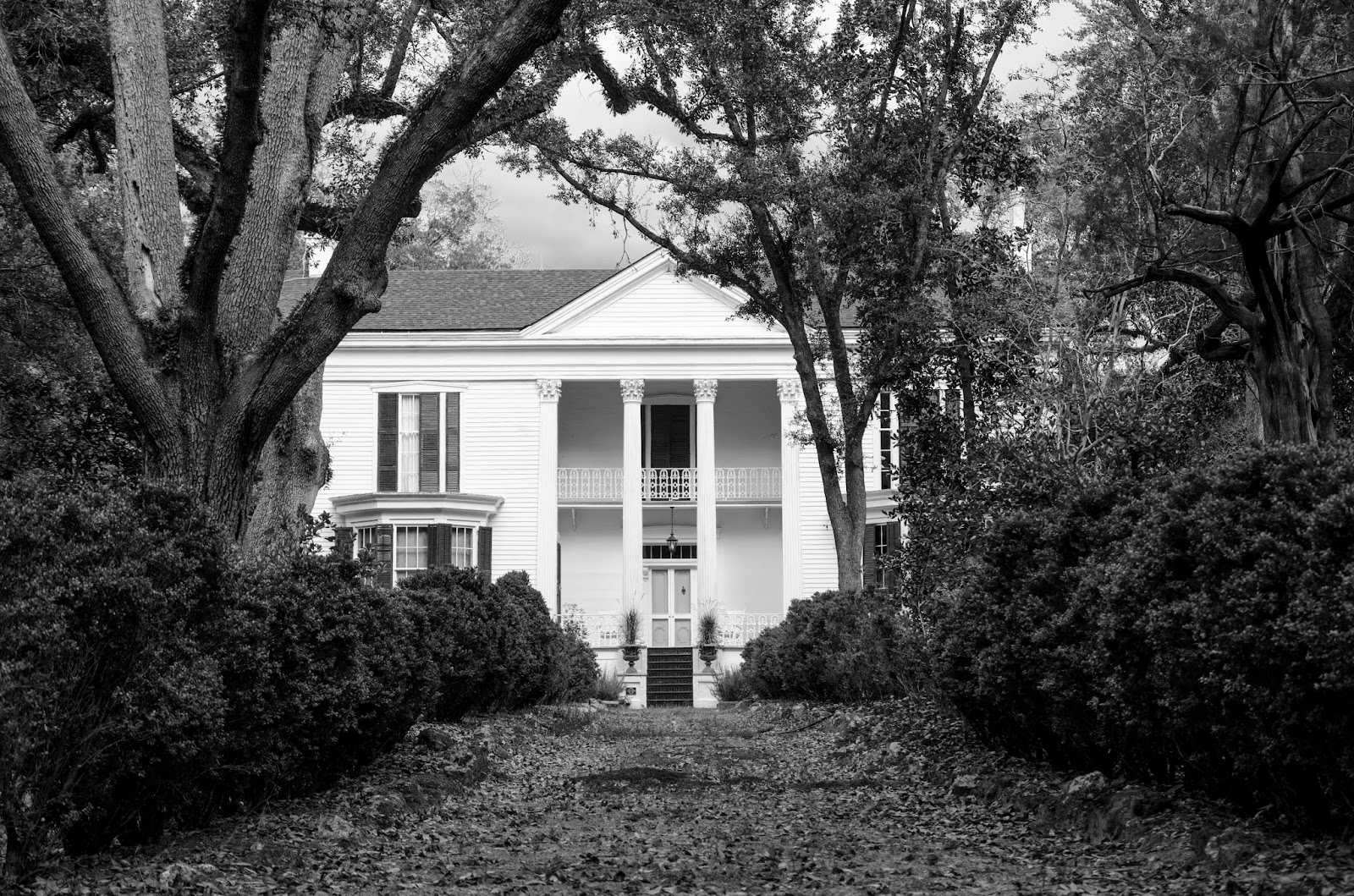
From Swainsboro we traveled north toward Midville where we took Ga. 17 east toward Millen. Along the way I stopped at several cotton fields to make images. Before Millen, we took a detour to a place called Birdsville. It is the site of an antebellum plantation that suffered tragically from the passing of Sherman’s Army. It is you classic plantation with the ancient Live Oaks overhanging the lane that leads to the front of the house. It was truly a beautiful location. It has been in the same family since the King granted them the land in 1785. From Birdsville we went to Buckhead Church on Buckhead Creek.
After leaving Buckhead Church, we drove through Millen and then continued on Ga. 17 towards Savannah. Along the way we stopped to photograph the Little Ogeechee Baptist Church and then passed through Guyton and between Guyton and Bloomingdale, I photographed Zion Lutheran Church.
All in all it was a very productive day and I turned what is normally a six hour drive in to a 12 hour drive.
Below is an image of Birdsville Plantation.
Catching Up: Photography Days 38, 39, 40, and 41 are complete
I have been very busy of late and have not been able to update the website as quickly as I would like so I am combining multiple post here.
Day 38: I photographed the Battle of Atlanta reenactment and had a fantastic time. It was really one of the best reenactments that I have seen this year. The field was covered with infantry and cavalry. There were about 40 cannons firing as well. I am looking forward to next years event.
Day 39: I went to the Living History event at Allatoona Pass on Saturday morning to make some candid shots of the reenactors during the day then went home for a little while, before returning to make images of the cannons firing at night during the candle light tour. Really great shots.
Day 40: I returned to the Living History event at Allatoona Pass and took my boys with me. They love to see the cannon fire. I was able to capture more candid images as well as a great shot of the Cherokee Battery firing.
Day 41: I again returned to Allatoona Pass on Monday to do an extensive photographic study of the earthworks and the old railroad bed.
150 Years Ago Today: October 4th, 1864
October 4th, 1864:
On the 3rd, Stewart’s Corps marched on and took Big Shanty and the garrison there, they began destroying the railroad. Lroing’s Division was sent to Acworth and Walthall’s Division went to Moon Station about two miles north of Big Shanty. Upon arriving at Acworth, Loring’s Division camped just outside of town.
On the morning of the 4th, the acting commander of the Federals in Acworth, attacked the Loring. The Federals had been up all night and were preparing for the Rebels to attack at first light, when they did not attack, the Federals did. The attack was a surprise to many of the men, but once the Confederates reorganized after the initial assault, they were able to surround the town and force the Federals to surrender. The Federal prisoners were rounded up and sent on their way, meanwhile the Confederates began to destroy the railroad. In all they were able to destroy about eight miles of track running north from Big Shanty.
Around noon on the 3rd Stewart received an order from Hood, directing him to send two of his Divisions back toward the main Confederate Army and send French’s further north to Allatoona Pass to destroy the tacks and fill in the railroad cut. After that they were to march to New Hope Church and link up with the other Divisions of the Corps. If French was able to determine if the garrison at the bridge over the Etowah was small, he was to attack and destroy the bridge if possible.
Having marched all the previous day and having spent all night and the morning destroying the railroad, French’s Division began marching north toward Allatoona. They were the furthest Division of their Corps, but were ordered their straight away. They had 8 miles to march, Loring’s Division, also the largest of the Corps, was only 4 miles away, but had been ordered to return back to the Confederate Army.
Sherman’s forces were also on the move. They were making their way toward Marietta and had already crossed the Chattahoochee by the the end of the day. Sherman also sent word to General Corse, who was in garrison at Rome, to move his division to Cartersville and to be ready to offer support when needed. Late in the afternoon, Sherman changed his orders to Corse and ordered him to Allatoona.
French’s Divison was on the move to Allatoona by foot and Corse was moving a greater distance, but had the advantage of using the railroad. It was essentially a race, yet the racers did not know they were racing.
150 Years Ago Today: October 2nd, 1864
October 2, 1864
Sherman began to receive reports that General Hood had crossed the Chattahoochee River and were moving toward Marietta. Sherman, unsure of where Hood was moving, began send messages to all points along his supply line and also sent additional troops to Chattanooga. He thought Hood would do one of two things; attack the supply line between Atlanta and Chattanooga or move toward northern Alabama to meet up with General Forrest to attack the supply depots in Tennessee. Sherman also mobilized his troops in Atlanta in an attempt to chase down and engage Hood. He left the XX Corps to garrison Atlanta and move the remaining troops northwest toward Marietta.
Hood was moving toward the northwest as well. He was not moving on Marietta directly and was making a wide move around it and the formidable Kennesaw Mountain. As the Confederate Army was marching, General Stewart’s Corps was the farthest to the right (east) of the column. They marched throughout the day and Stewart’s Corps made camp a few miles south of Lost Mountain. Hood and the remainder of his army camped in area southeast of Dallas near Flint Hill Church.
On the evening of the October 2nd, Hood sent orders to Stewart. His orders were to move his entire Corps, in the morning, to Big Shanty (now called Kennesaw). Stewart was assigned to capture and destroy as much of the railroad as possible and if he was able to take Big Shanty, he was to send a Division to Acworth to do the same thing there. Hood suggested that he should be back in two days to link up with the remainder of the army. These actions, were to set into motion, all the pieces for the Battle of Allatoona Pass.
150 Years Ago Today: Late September
Late September 1864:
Sherman has fortified Atlanta extensively and has started to build up supplies and rest his troops. The Confederates are not sitting idle, and Hood has ordered all the Federal prisoners kept at Andersonville to be moved to different prisons out of the reach of Sherman’s forces. Hood then shifts his Army from Love Joy’s Station to Palmetto, which lies along the railroad to West Point and further into Alabama. Hood is resting his troops, building up supplies and making plans for a move to the north to attack Sherman’s supply line.
Confederate President Davis arrives in Palmetto on September 25th. The next morning he begins a review of the troops and is greeted with silence, not cheers for their President. A few soldiers yell out to the President asking for General Johnston to be place back in command, but these remarks fall upon deaf ears. Bringing Johnston back would be like admitting the he made a mistake in removing him.
On the 27th, Davis meets will Hood and all his Corps Commanders and some of the Divisional Commanders. A great deal is discussed including a plan to strike Sherman’s supply and communications lines north of Atlanta, there by cutting him off and forcing him to retreat back to Tennessee, all the while being engaged by Hood. Hood then thinks he can move on the Federals in Tennessee and turn the tide of the war in the western theater and possibly as a whole. Hood also complains to Davis about General Hardee and blames the loss at Jonesboro on him. He ask Davis to remove him. Davis agrees and Hardee readily accepts the offer to command the coastal defenses of Georgia, South Carolina, and Florida. Hardee is relieved to out from under Hood’s command. On the 28th, Hood receives word from Davis that he may move forward with his plans to on North.
On September 29th and 30th, the Confederate Army of Tennessee begins their next march and cross the Chattahoochee River near Palmetto and Campbellton about 40,000 troops. By late in the evening of October 1st, Hoods army has moved about 8 miles from the river crossing in the direction of Marietta. Sherman, who had anticipated this move to the north by Hood a week earlier, had already sent troops to Rome and to Chattanooga to help protect those areas from the threat of Hood and from the threat of General Nathan Bedford Forrest cavalry that has started operating in the northern part of Alabama and into Tennessee.
150 Years Ago Today: September of 1864
After the Battle of Jonesboro, Sherman’s Army followed the Confederates to Love Joy’s Station, where Hood rejoined Hardee with Stewart’s and Lee’s Corps. Sherman skirmished a day or so and then after learning that the XX Corps had entered Atlanta, he withdrew from Love Joy’s Station and marched back to Atlanta to claim his prize and losing what many consider to have been a prime opportunity to crush Hood and the Army of Tennessee once and for all. Having taken Atlanta, Sherman decided he had reached his objective and did not think it was worth the bloodshed to continue pressing his advantage.
Upon entering Atlanta, Sherman established his headquarters and began to restore order to the town. He decided that it was a military outpost and ordered all civilians to evacuate. A truce was negotiated with Hood, who was not happy about civilians being forced from their homes, and the civilians were given a choice of taking a train north or one to the south. The ones that choose a train south, were sent to Rough and Ready, where they had to disembark and travel to Love Joy’s Station by wagon. About half the cities population went north and the other half went south. There were some civilians that were allowed to stay as they were given jobs by the Federals.
Poe, Sherman’s Chief Engineer, immediately started to rebuild and strengthen the defensive line around the city. He built artillery forts connected with infantry trenches. With much of the city in ruin, the soldiers started to use building materials from destroyed structures to begin building small shacks as living quarters. Sherman also began to rest and resupply his armies in preparation for his next sortie into the heart of the Confederacy.
Many of the period images that exist of Atlanta come from this time of the campaign. George Barnard entered the city to document the Federal occupation. There are many iconic images of the Federals and their forts in Atlanta.
 War Was Here